


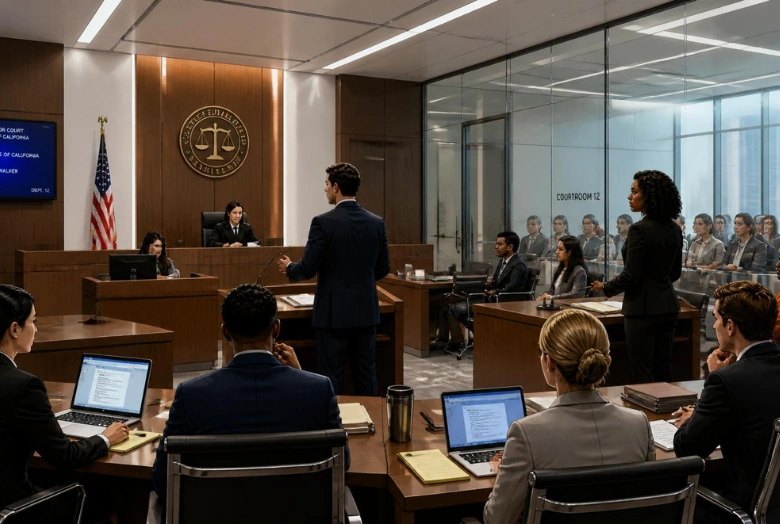
Walking into a court room for the first time can feel intimidating because nearly every seat, desk, railing, and person appears to have a specific purpose. Although courtroom designs differ between federal, state, and local courts, most U.S. courtrooms follow a recognizable structure that helps judges, attorneys, witnesses, jurors, and the public participate in proceedings. Understanding that structure can make a courthouse visit easier whether you are appearing in a case, serving as a juror, supporting someone, or simply observing a public hearing.
Direct answer: A courtroom is the room where a judge conducts hearings or trials. In a typical U.S. courtroom, you may see a judge’s bench, witness stand, jury box, counsel tables, clerk and reporter stations, a security officer, and public seating behind the bar.
What Is a Court Room?
A courtroom is a designated space where a court conducts judicial proceedings such as hearings, motions, trials, pleas, sentencing proceedings, and other legal matters. The standard American spelling is normally “courtroom” as one word, although people frequently search for or write the phrase as “court room.” Dictionaries define a courtroom essentially as the room in which the sessions of a court are held.
The room is designed for more than simply placing a judge at the front and lawyers at tables. Its physical arrangement separates active participants in a case from spectators while giving judges, attorneys, witnesses, jurors, and court staff appropriate sightlines and working areas. Federal guidance notes that exact layouts differ between locations, but the same general components appear in courtrooms throughout the country.
A courtroom is also different from the courthouse itself. The courthouse is the larger building that may contain several courtrooms along with judges’ chambers, clerk offices, jury rooms, security areas, conference rooms, records facilities, and public spaces. A single courthouse can therefore contain many separate courtrooms serving different judges and types of proceedings.
Court Room or Courtroom: Which Spelling Is Correct?
In standard American English, “courtroom” is normally written as one word. Major dictionaries use “courtroom” for the room in which a court holds its sessions, and U.S. judicial websites generally follow the same spelling.
The two-word form “courtroom” is still easy to understand and commonly appears in searches, informal writing, and some older or institutional materials. It does not change the basic meaning, but “courtroom” is the better form for formal American writing. Readers searching either version are generally looking for the same information about a court’s physical room, people, procedures, or rules.
Standard Courtroom Layout in the United States
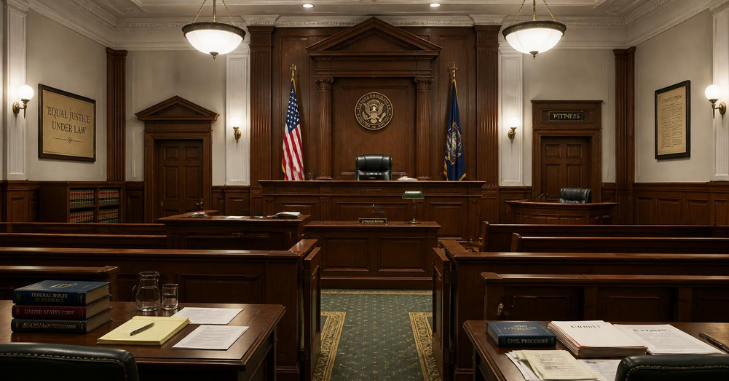
No single floor plan applies to every American courtroom because the design depends on the court, building, case type, security needs, and whether juries are used. Even so, U.S. federal guidance describes a recognizable arrangement that normally includes the public gallery, a separating bar or railing, the courtroom well, counsel tables, the judge’s bench, a witness stand, staff stations, and often a jury box.
| Courtroom Area | Main Purpose | Who Usually Uses It |
| Judge’s bench | Location from which the judge presides | Judge |
| Witness stand | Place where a witness gives testimony | Witnesses |
| Jury box | Seating for jurors during a jury trial | Jurors |
| Counsel tables | Work areas for the parties and attorneys | Lawyers and parties |
| Lectern or podium | Position used when addressing the judge or jury | Attorneys |
| Clerk’s station | Administrative support and exhibit management | Courtroom clerk/deputy |
| Court reporter station | Creation of the formal record | Court reporter |
| Well of the court | Main area where proceedings occur | Authorized participants |
| Bar or railing | Separates the active court area from spectators | Court personnel control access. |
| Gallery | Public seating | Visitors, family, media, observers |
The Judge’s Bench
The judge’s bench is the raised work area at the front of most trial courtrooms and forms the visual center of the room. The judge presides from this position, rules on legal questions, manages the proceeding, and makes decisions that fall within the judge’s authority. Court design guidance emphasizes that the bench should allow the judge to see and hear the people participating in the proceeding.
The elevated position is practical as well as symbolic because it gives the judge a clear view of the courtroom. It should not be interpreted to mean that every case is decided by the judge alone, since a jury determines disputed facts in many jury trials. In a bench trial without a jury, however, the judge also performs the fact-finding role.
The Witness Stand
The witness stand is the designated place from which witnesses testify after taking the required oath or affirmation. It is normally positioned near the judge and arranged so that the judge, attorneys, jurors, and court reporter can see or hear the witness clearly. Federal courtroom descriptions commonly place it beside the bench and near the jury box.
Witness testimony can be central to both civil and criminal cases because witnesses provide evidence about disputed events, observations, professional opinions, or other relevant facts. Attorneys may question a witness through direct examination and cross-examination according to applicable procedural and evidentiary rules. The witness remains subject to the judge’s control while testifying.
The Jury Box
The jury box is a group of seats reserved for jurors and is usually positioned along one side of the courtroom’s well. Its location is intended to give jurors a clear view of witnesses, attorneys, exhibits, and the judge while allowing them to hear the proceeding. Some modern courtrooms also include monitors or other technology to help jurors review evidence presented during trial.
A jury box does not mean that a jury will be present at every hearing. Many proceedings take place before a judge without jurors, and some types of cases are routinely resolved through motions, pleas, settlements, or bench proceedings. When a jury is used, the judge instructs jurors on the applicable law while jurors decide factual questions based on admitted evidence.
Counsel Tables and the Lectern
Counsel tables sit inside the courtroom well and provide working space for attorneys and, depending on the proceeding, their clients or other authorized members of the legal team. In a federal criminal courtroom, one table normally accommodates government counsel while another serves the defense. The exact orientation can change from one courthouse to another, so visitors should not assume that a particular side of the room always belongs to one party.
A lectern or podium may stand between the counsel tables and the judge. Attorneys often use it when making arguments, questioning witnesses, or addressing the court, although individual judges may have their own practices about where lawyers should stand. Modern courtrooms may equip counsel tables and lecterns with microphones, monitors, laptop connections, and evidence-presentation systems.
The Bar, Well, and Public Gallery
The bar is the physical or functional boundary separating the public section of a courtroom from the area where the proceeding takes place. The space inside that boundary is commonly called the well of the court, and access is generally restricted to people authorized to participate in the proceeding. The gallery sits behind the bar and provides seating for members of the public, relatives, journalists, students, and other observers.
This separation helps courts maintain security and an orderly proceeding while preserving public access where appropriate. Visitors should therefore remain in the gallery unless court personnel specifically direct them somewhere else. Walking through the bar or approaching counsel tables without permission can interfere with court operations and should be avoided.
Who Is Who in a Courtroom?
Several people may be present during a U.S. court proceeding, but not every hearing includes every role. A trial may involve a judge, clerk, reporter, bailiff or security officer, attorneys, parties, witnesses, jurors, and interpreters, while a short procedural hearing may involve only a few of those participants. Arizona’s court system similarly identifies judges, reporters, clerks, bailiffs, attorneys, parties, witnesses, interpreters, and jurors among the central courtroom participants.
| Person | Typical Role |
| Judge | Presides, applies the law, rules on legal issues, and manages proceedings. |
| Jury | Determines factual issues in cases tried by a jury |
| Plaintiff | Party bringing a civil lawsuit |
| Defendant | Party defending a civil claim or person accused in a criminal case |
| Prosecutor | Represents the government in a criminal prosecution |
| Defense attorney | Represents a criminal defendant |
| Civil attorney | Represents a party in a civil dispute |
| Witness | Gives testimony or evidence |
| Clerk/courtroom deputy | Handles administrative courtroom functions and exhibits |
| Court reporter | Creates the official verbatim record where applicable |
| Bailiff/security officer | Helps maintain safety and courtroom order |
| Interpreter | Assists participants who require language interpretation |
The Judge and Jury
The judge is responsible for controlling the proceeding and applying relevant legal rules. In a jury trial, the judge rules on legal matters and instructs jurors about the law, while the jury evaluates evidence and determines factual issues. In a trial without a jury, the judge can decide both legal and factual questions.
Jurors must remain neutral and decide a case from the evidence properly presented in court rather than from outside information. For that reason, courts place strict limits on communication with jurors during an active case. Spectators, parties, witnesses, and family members should never attempt to discuss the case with a juror.
Attorneys and Parties
Attorneys present their clients’ positions through arguments, motions, witness examinations, documentary evidence, and other procedures permitted by the court. A civil case generally has a plaintiff and a defendant, while a criminal case involves the government and the accused defendant. Some parties represent themselves, a status commonly described by the Latin term pro se.
Different types of cases also require different legal preparation before anyone reaches the courtroom. For example, readers dealing with professional-negligence issues can review Magazetty’s guide to what a malpractice lawyer does, while property-injury disputes are covered in its premises liability lawyers guide. Those topics show why the evidence and legal questions presented inside a courtroom can differ dramatically from one case to another.
Clerk, Court Reporter, and Courtroom Security
The courtroom clerk or deputy assists with the orderly administration of proceedings and may handle exhibits, administer oaths, record courtroom activity, and coordinate practical aspects of a hearing. The court reporter creates a verbatim record when a reporter is used, while some courts also employ authorized electronic recording systems. Federal job descriptions show that courtroom deputies may perform a broad range of duties related to scheduling, exhibits, witness oaths, minute entries, and the orderly flow of proceedings.
Security functions may be performed by bailiffs, deputy sheriffs, court security officers, or U.S. Marshals personnel depending on the jurisdiction and courthouse. Historically, bailiffs maintained courtroom order and assisted with juries, although many federal bailiff functions are now performed by courtroom deputies or other personnel. Visitors should follow directions from security staff even when procedures differ from what they have seen in another courthouse.
What Happens in a Courtroom?
What happens after court begins depends heavily on the type and stage of the case. A courtroom may host a short scheduling conference, a motion hearing lasting several hours, jury selection, a multi-day trial, a plea hearing, sentencing, or another judicial proceeding. Television dramas tend to focus on witness questioning and verdicts, but much of real court work involves procedural matters that occur before or instead of a full trial.
A simplified trial sequence may include:
- Court is called to order.
- Preliminary or procedural matters are addressed.
- A jury is selected when the case requires one.
- Attorneys may make opening statements.
- The parties present witnesses and other evidence.
- Witnesses may undergo direct examination and cross-examination.
- Attorneys may make closing arguments.
- The judge gives legal instructions to the jury when applicable.
- Jurors deliberate and return a verdict, or the judge decides a bench trial.
- Additional proceedings may follow, such as sentencing or post-trial motions.
Not every case reaches all of these stages because disputes can end through dismissal, settlement, plea agreements, or rulings made before trial. The precise sequence is also controlled by the jurisdiction, type of court, applicable procedural rules, and instructions of the presiding judge. Anyone directly involved in a case should therefore rely on the court and qualified legal counsel rather than a generic online description of courtroom procedure.
Civil vs. Criminal Courtrooms
Civil and criminal courtrooms often look similar physically, but the cases and roles inside them differ. Civil cases typically involve disputes between individuals, businesses, organizations, or government entities, while criminal proceedings involve allegations that a defendant violated criminal law. The labels used at counsel tables therefore change depending on what kind of case the court is hearing.
| Feature | Civil Case | Criminal Case |
| Main sides | Plaintiff and defendant | Government/prosecution and defendant |
| General purpose | Resolve a legal dispute or claim | Determine issues involving alleged criminal conduct. |
| Possible jury | Yes, in qualifying cases | Yes, in qualifying cases |
| Possible judge-only proceeding | Yes. | Yes, depending on the proceeding and legal requirements |
| Common outcomes | Judgment, damages, injunction, dismissal, settlement | Acquittal, conviction, dismissal, plea, sentencing |
Readers should avoid assuming that every legal dispute seen in a courtroom is a criminal matter. Even familiar terms can have different legal consequences depending on the jurisdiction and circumstances, as Magazetty’s loitering meaning and legal context guide demonstrate. For more plain-language material on different kinds of cases, readers can also explore Magazetty’s broader Law section.
Courtroom Etiquette for Visitors
Courtroom etiquette exists to keep proceedings orderly, respectful, safe, and free from unnecessary distractions. Rules vary by courthouse and judge, so visitors should check the relevant court’s website before arriving rather than relying entirely on customs from another court. Federal courts specifically advise visitors to review local policies on electronic devices because rules concerning phones, laptops, and tablets can differ between courthouses.
Common expectations include:
- Arrive early enough to pass through courthouse security.
- Dress in clean, respectful clothing suitable for a formal public setting.
- Follow instructions from court security officers and courtroom staff.
- Stand when instructed to do so.
- Remain quiet while proceedings are in progress.
- Do not interrupt attorneys, witnesses, the judge, or other participants.
- Keep aisles and doorways clear.
- Do not enter the courtroom well unless authorized.
- Avoid unnecessary entrances and exits during a hearing.
- Check the court’s policy before bringing or using a phone, laptop, camera, or recording device.
- Never communicate with jurors about the case.
Federal court rules provide an important example of why checking local requirements matters. The federal judiciary’s guidance on cameras in federal courts states that photography, broadcasting, and audio recording during federal courtroom proceedings are prohibited, while individual courts set their own policies concerning which electronic devices may enter the courthouse.
Can the Public Sit in a Courtroom?
Most federal courtroom proceedings are open to members of the public, generally on a first-come, first-served basis. Someone who wants to observe can typically check the local federal court calendar and attend an available proceeding in person. Limited exceptions may apply when privacy, security, sensitive information, juvenile matters, or available seating justify restrictions.
State and local courts also commonly provide public access to many proceedings, but their rules and schedules are jurisdiction-specific. A hearing being listed on a docket does not automatically guarantee unlimited seating, and judges can impose appropriate restrictions when legally permitted. Anyone planning a visit should check the specific court’s calendar, security procedures, and public-access information beforehand.
Accessibility and Technology in Modern Courtrooms
Modern courtrooms increasingly include microphones, monitors, digital evidence systems, assisted-listening equipment, and connections for computers or presentation technology. A federal district court in Washington, for example, describes touch-panel monitors, document cameras, microphones, attorney-table connections, jury monitors, and assisted-listening accommodations among its courtroom technology.
Accessibility is also part of courtroom design because litigants, witnesses, jurors, attorneys, staff, and spectators may have different mobility, hearing, vision, or communication needs. U.S. Access Board guidance explains that courtrooms contain clearly defined areas for the judiciary, support staff, litigants, attorneys, jurors, prisoners, and the public, all of which must be considered in courthouse accessibility.
Technology does not mean visitors may freely record proceedings. Court-owned presentation equipment and accessibility tools operate under judicial control, while personal-device rules can be much stricter. Visitors who need an accommodation or assistive technology should contact the relevant courthouse in advance so court staff can explain available arrangements and procedures.
How to Prepare Before Going to Court
Preparation begins before you enter the courthouse because security screening, parking, transportation, courtroom locations, and local device policies can take more time than expected. Confirm the courthouse address, room number, hearing time, and any instructions contained in your notice or court paperwork. Federal courts advise visitors to expect security screening and to review local restrictions on items permitted inside the building.
If you are a party, witness, or juror, follow the specific instructions issued for your role rather than relying only on general courtroom guidance. Bring required documents in an organized form, allow enough time to arrive before the scheduled proceeding, and ask authorized court personnel where to go if the layout is unfamiliar. Do not discuss confidential case information with strangers in courthouse hallways simply because they appear to be connected with the proceeding.
Observers have fewer responsibilities but should still learn the basic rules before attending. Check whether the proceeding is open, whether seating is limited, and whether personal electronics may enter the courthouse or courtroom. Knowing these details in advance allows you to focus on the proceeding instead of dealing with avoidable security or etiquette problems.
Final Takeaway
A court room may look formal and complicated, but its design follows a practical purpose: keeping legal proceedings organized while giving each participant an appropriate place to work, testify, decide issues, or observe. The judge’s bench, witness stand, jury box, counsel tables, courtroom well, bar, staff stations, and public gallery all contribute to that structure. Once you understand those basic areas and the roles of the people using them, entering a U.S. courtroom becomes much less confusing.
The most important rule for any real courthouse visit is to check the specific court’s instructions before you arrive. Access rules, courtroom procedures, electronic-device policies, security requirements, and local practices can differ considerably between jurisdictions.
Frequently Asked Questions
What does “courtroom” mean?
A court room is the physical room in which a court conducts hearings, trials, and other judicial proceedings. In standard American English, the word is normally written “courtroom” as one word. The room typically contains designated areas for the judge, attorneys, witnesses, court staff, and spectators, with additional jury seating when required.
What is the main part of a courtroom called?
The active area where the principal participants conduct the proceeding is commonly called the well of the court. It is generally located beyond the bar or railing that separates spectators from authorized participants. The judge’s bench, counsel tables, witness stand, jury box, and staff work areas are usually positioned in or around this central area.
Where does the judge sit in a courtroom?
The judge generally sits at a raised bench at the front of the courtroom. This location gives the judge clear sightlines to counsel, witnesses, jurors, court staff, and the public area. Courtroom designs vary, however, so the precise position and arrangement are not identical in every courthouse.
Where does the public sit?
Members of the public normally sit in the gallery, which is the spectator area behind the courtroom bar. Visitors should stay in that area unless a court employee directs them to another location. Most federal proceedings are open to the public, although access may sometimes be limited by available space, security concerns, privacy considerations, or other legal reasons.
Can I bring my phone into a courtroom?
That depends on the particular courthouse because electronic-device rules vary. Some courts allow phones into the building but require them to be turned off in courtrooms, while others impose stricter entry rules or additional restrictions. Federal courts advise visitors to check the court’s own rules or contact the clerk’s office before arriving.
Can I take pictures inside a courtroom?
You should never assume that photography is allowed during a court proceeding. U.S. courts state that photography, broadcasting, and audio recording during federal courtroom proceedings are prohibited, and individual courts may impose additional restrictions in other areas of a courthouse. Always check the rules of the particular state, local, or federal court you plan to visit.
Does every courtroom have a jury box?
No, because many proceedings do not involve juries and some courtroom designs are intended primarily for non-jury matters. Courts may conduct motions, pleas, scheduling matters, bench trials, and other proceedings without a sitting jury. Courtroom configurations therefore depend partly on the type of court and the proceedings the room is designed to handle.
What is the difference between a court and a courtroom?
A court can refer to the judicial institution, judge, or legal body exercising judicial authority, while a courtroom is the physical room where proceedings occur. A courthouse is the larger building that can contain multiple courtrooms and other judicial offices. Keeping these three terms separate makes legal descriptions much easier to understand.
