



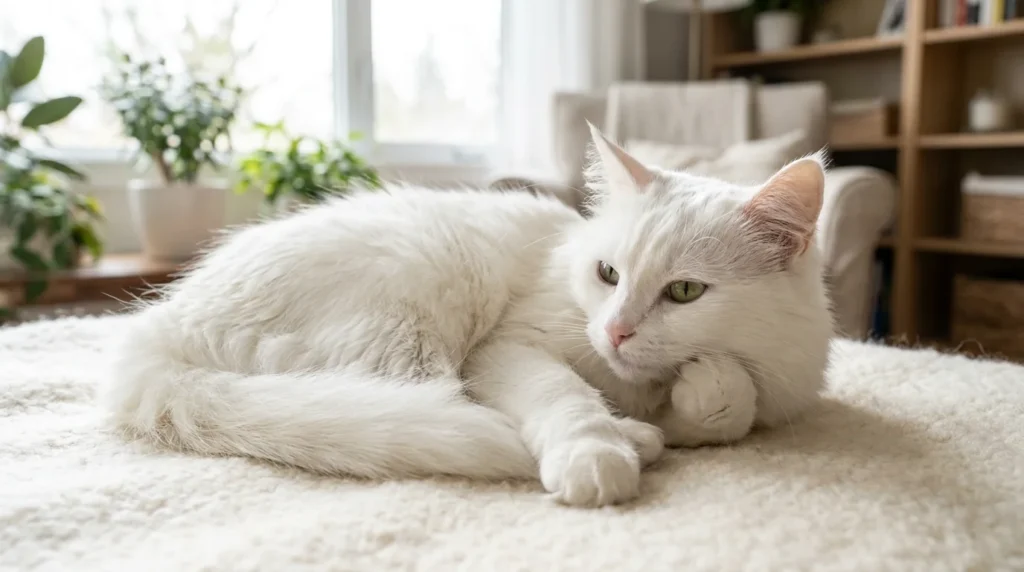
A white cat can be impossible to overlook, whether it has bright blue eyes, an unusual odd-eyed appearance, or a long snow-colored coat. Yet the color tells you much less about a cat’s breed or personality than many popular myths suggest. For current and prospective owners, the important differences involve genetics, hearing, sun exposure, grooming needs, and the individual cat behind that striking coat.
Quick answer: A white cat is not a single breed; it is a cat whose coat appears completely white because of particular pigmentation genes, extensive white spotting, or, rarely, albinism. These cats may have blue, green, gold, copper, or odd-colored eyes, and some, especially blue-eyed individuals, have a higher risk of congenital deafness.
Key Facts at a Glance
| Feature | What to Know |
|---|---|
| Is a white cat a breed? | No. White is a coat color found in numerous purebred and mixed-breed cats. |
| Possible eye colors | Blue, green, gold, copper, or two different colors |
| Is every white-coated cat deaf? | No. Risk is higher in some of them, particularly those with blue eyes. |
| Are blue-eyed white-coated cats blind? | No. Blue eyes and a white coat do not inherently increase the risk of blindness. |
| Is every white coat a sign of albinism? | No. True feline albinism is rare and genetically different from dominant white coloring. |
| Special care | Pay attention to hearing, sun exposure, grooming, and routine veterinary care. |
| Personality | Coat color alone does not reliably determine temperament. |
What Is a White Cat?
A cat described this way is simply a feline whose visible coat is entirely or almost entirely white, rather than a member of one particular breed. Persians, Maine Coons, Turkish Angoras, American Shorthairs, British Shorthairs, Norwegian Forest Cats, and several other breeds can produce white individuals, while mixed-breed domestic cats can be white as well. Current breed guides likewise show that white coloring occurs across cats with very different sizes, coat lengths, and physical characteristics.
That distinction matters because choosing a cat based only on color can create unrealistic expectations about grooming, energy level, or temperament. A white Persian and a white short-haired domestic cat may look similar in color, but have very different coat maintenance needs and inherited health considerations. Owners should therefore, when possible, identify the breed or likely ancestry and evaluate the individual cat rather than treating coat color as a breed profile.
Why Are Some Cats Completely White?
Several genetic mechanisms can create white coloring, and they are not all the same. The University of California, Davis Veterinary Genetics Laboratory identifies dominant white and white spotting variants that influence how pigmentation appears in a cat’s coat. A dominant white variant can produce a completely white appearance, while white-spotting variants can produce anything from limited white areas to extensive white coverage.
A dominant white coat can effectively mask colors the cat would otherwise display because pigment-producing cells do not develop normally throughout the coat. This is different from having a few white paws, a white chest, or another clearly defined spotting pattern. Genetics can therefore make two visually similar cats biologically different in terms of how their coloring developed.
Is a White Coat the Same as Albinism?
Most cats with white coats are not albino, even when they have blue eyes. UC Davis describes feline albinism as a rare inherited condition involving a mutation in the TYR gene, whereas dominant white coloring results from a different genetic mechanism. The laboratory notes that true albinism is uncommon among cats submitted for genetic testing.
This distinction also explains why a white-coated cat may have normally pigmented green, gold, or copper eyes. A cat with a dominant white coat can still retain pigment in parts of the eyes even though the fur appears entirely white. Appearance alone is therefore not enough to establish that a cat has albinism.
Popular Breeds With White Coats in the United States
Many recognized cat breeds can produce white individuals, and the right choice depends much more on breed characteristics than coat color. Prospective owners should consider grooming demands, adult size, activity level, inherited conditions, and the amount of daily interaction a particular cat needs. These are several breeds U.S. cat owners may encounter in white.
| Breed | Coat | Practical Consideration |
|---|---|---|
| Persian | Long and dense | Requires frequent coat and face care |
| Turkish Angora | Medium-long, silky | Athletic coat is generally less dense than a Persian’s |
| Maine Coon | Long and shaggy | Large size and abundant coat increase grooming needs |
| American Shorthair | Short and dense | Usually easier coat maintenance |
| British Shorthair | Short and plush | Dense coat benefits from routine brushing |
| Norwegian Forest Cat | Long, weather-resistant | Seasonal shedding can be considerable |
| Oriental Shorthair | Very short | Minimal brushing compared with long-haired breeds |
| Devon Rex | Short and curly | Coat and skin care differ from conventional short-haired cats |
| Khao Manee | Short, traditionally white | Known for blue, gold, or odd-colored eyes |
The Khao Manee is particularly associated with an all-white appearance, while most breeds in the table occur in many other colors as well. Breed identification can also be difficult without pedigree documentation because a fluffy white rescue cat is not automatically a Persian, Turkish Angora, or Maine Coon. Shelters and owners are often better served by describing an unknown cat as a domestic shorthair or domestic longhair unless its ancestry is documented.
Why Do Some White-Coated Cats Have Blue Eyes?
Blue eyes in many of these cats are connected to reduced pigmentation in the iris rather than blue pigment being deposited there. The same developmental processes that affect pigment cells can influence the coat, eyes, and structures involved in hearing, which helps explain the association among a white coat, blue eyes, and congenital deafness. UC Davis research reports marked differences in pigmentation between the eyes of blue-eyed and non-blue-eyed cats carrying dominant white alleles.
Cats with white coats can also be odd-eyed, meaning one eye is blue while the other may be green, gold, or another color. This condition is called heterochromia and can produce an especially striking appearance without automatically indicating disease. Eye color should still be considered alongside hearing status because the association with congenital deafness is more pronounced when one or both eyes are blue.
Are White Cats Deaf?
No, being white does not automatically mean a cat is deaf. However, hereditary deafness occurs more frequently among cats with white coats, and the risk rises substantially when blue eyes are present. Cornell University’s Feline Health Center reports markedly different rates according to eye color.
| Eye Color | Reported Congenital Deafness Rate |
|---|---|
| No blue eyes | 17% to 22% |
| One blue eye | About 40% |
| Two blue eyes | About 65% to 85% |
These percentages are useful for understanding risk, but they do not predict an individual cat’s hearing status. Plenty of blue-eyed individuals can hear, while a cat with a white coat and non-blue eyes can still be deaf in one or both ears. A cat that is deaf in only one ear may behave so normally that the hearing difference remains unnoticed without testing.
Are Blue-Eyed Cats With White Coats Also More Likely to Be Blind?
The common belief that blue-eyed white-coated cats routinely become blind is a myth. Cornell specifically states that they are not more predisposed to hereditary or acquired blindness than other cats simply because of their coloring. The genuine genetic concern associated with this appearance is hearing rather than eyesight.
Owners should still take any change in vision seriously, as these cats can develop the same eye diseases, injuries, infections, and age-related conditions seen in the broader feline population. Cloudiness, persistent redness, discharge, enlarged pupils, bumping into objects, or sudden reluctance to jump warrants veterinary attention. Those symptoms should be evaluated on their own rather than assumed to be caused by coat color.
How Can You Tell Whether Your Cat Is Deaf?
Home observations can raise suspicion, but they cannot reliably diagnose one-sided hearing loss. A cat that does not react to a vacuum, a oor sound, a a a d container, or a voice when it cannot see the source may have impaired hearing, although sleep, distraction, and vibration can easily confound informal tests. Cats with hearing in only one ear can be particularly difficult for owners to identify.
The most definitive clinical approach is a brainstem auditory evoked response, commonly called a BAER test. It measures the electrical activity produced as sound signals travel through the auditory system and can determine whether a cat hears with one ear, both ears, or neither. The University of Florida notes that kittens should be at least six weeks old for its BAER procedure because younger animals have incompletely developed hearing pathways.
Living With a Deaf Cat
Congenital deafness does not prevent a cat from having an active and rewarding life. Deaf cats learn to rely more heavily on visual signals, floor vibrations, routine, scent, and predictable interaction with the people around them. The largest practical issue is safety because a deaf cat cannot hear approaching cars, dogs, people, or other outdoor hazards.
Keeping a deaf cat indoors or using a secure enclosure or supervised leash can substantially reduce those risks. Owners can also use hand signals, visible gestures, gentle floor vibrations, or lights to get the cat’s attention without startling it. Family members should approach a sleeping deaf cat carefully and teach children not to grab the animal from behind unexpectedly.
Do White-Coated Cats Need Extra Protection From the Sun?
White and lightly pigmented cats deserve particular attention around prolonged sunlight exposure. Cornell explains that ultraviolet radiation is an important cause of feline cutaneous squamous cell carcinoma and that tumors related to solar exposure occur particularly in white or lightly pigmented cats on sparsely haired areas. The ears, eyelids, nose, and surrounding facial skin are among the vulnerable locations.
Sun-related damage may initially resemble redness, scaling, crusting, or a small sore that repeatedly fails to heal. Those signs are worth showing to a veterinarian rather than assuming they are just ordinary or dry skin. Early evaluation matters because squamous cell carcinoma can invade nearby tissue as it progresses.
For prevention, Cornell recommends minimizing direct sunlight exposure, especially for white or lightly pigmented cats. Keeping a cat indoors during intense sun and providing shaded resting places are simple measures that do not require putting potentially inappropriate products on feline skin. Ask a veterinarian before applying any sunscreen or topical product because products made for humans are not automatically safe for cats.
How to Care for a White Coat
A white coat does not require a fundamentally different grooming system, but dirt, tear residue, and staining are often more visible against pale fur. Brushing according to coat length removes loose hair and helps owners notice mats, skin irritation, parasites, or small wounds before they worsen. Long-haired Persians, Maine Coons, and Norwegian Forest Cats generally need substantially more coat maintenance than short-haired ones.
Owners should avoid bleach, harsh whitening agents, and unapproved cosmetic productswhen tproducts when trying look brighter. Persistent staining around the eyes or mouth deserves investigation if it is accompanied by discharge, odor, irritation, discomfort, or a sudden change from the cat’s normal appearance. Cosmetic appearance should always come after skin and eye health.
A balanced diet, clean water, parasite prevention, dental care, vaccinations appropriate to lifestyle, and regular veterinary examinations remain the foundation of health for these cats just as they do for others. No special diet is required merely because the coat lacks color. Breed, age, medical history, body condition, and activity level are more useful factors when choosing nutrition.
Do Cats With White Coats Have a Special Personality?
Claims that every cat with a white coat is unusually shy, affectionate, aloof, calm, or aggressive should be treated cautiously. White coloring appears in many unrelated breeds and mixed-breed cats, so there is no single white-cat temperament that applies to all of them. Breed tendencies, genetics beyond coat color, early socialization, previous experiences, health, environment, and the individual animal all contribute to behavior.
A white Maine Coon may behave very differently from a white Persian, and two unrelated white domestic shorthairs can have completely different personalities. When adopting, spend time observing whether the individual cat enjoys handling, seeks interaction, tolerates household activity, and responds comfortably to unfamiliar people. Those observations are more useful than choosing a personality based on fur color.
What to Look for When Adopting
The striking coat may be what first catches your attention, but an adoption decision should focus on health and compatibility. Ask the shelter, rescue group, or breeder what is known about hearing, previous veterinary examinations, behavior, vaccination status, parasite control, and whether the animal has lived safely indoors. If the cat has blue eyes or behaves as if sound is difficult to locate, discussing a formal hearing assessment with a veterinarian can be helpful.
Look carefully at the ears, nose, eyelids, skin, coat, teeth, and general body condition rather than expecting perfect cosmetic whiteness. A deaf cat should not automatically be rejected, because hearing-impaired cats can adapt extremely well in safe homes. What matters most is whether your household can provide an indoor environment, appropriate veterinary care, enrichment, and predictable interaction.
For additional animal-related content, readers can also explore the Magazetty Pets section, which covers everyday care questions across companion animals. Articles on grooming routines, indoor enrichment, kitten care, and training a pet that cannot hear all pair well with this guide. Much of that general advice applies just as well to a pale-coated cat as it does to any other.
Final Thoughts
A white cat is much more than its eye-catching color, and understanding the genetics behind that color helps separate genuine health considerations from myths. Blue eyes can be associated with an increased risk of congenital deafness, but they do not mean that every one of these cats is deaf or destined to become blind. Sun protection, sensible grooming, hearing awareness, routine veterinary care, and a safe environment address the most important practical concerns.
Whether you are adopting a white kitten from a U.S. shelter or already live with an adult cat, focus on the individual animal rather than assumptions based on appearance. Learn its hearing status when necessary, watch pale skin for changes, choose grooming routines that match its actual coat, and build an environment suited to its personality. With those basics in place, these cats generally need what every companion cat needs most: appropriate health care, safety, enrichment, and consistent human attention.
Frequently Asked Questions
Are all-white coats rare?
Cats with entirely white coats are less commonly encountered than cats displaying one or more colored patterns, but “white cat” covers many breeds and mixed-breed animals rather than a single rare population. There is no dependable U.S. national percentage that applies to every shelter, breed, or cat population. A white coat should therefore be viewed as an appearance trait rather than proof that a cat is exceptionally rare.
Are all blue-eyed cats with white coats deaf?
No, but their risk is significantly higher than that of white-coated cats without blue eyes. Cornell reports congenital deafness in roughly 65% to 85% of all-white individuals with two blue eyes in the data it cites, which still means the appearance does not guarantee deafness. BAER testing can establish an individual cat’s hearing status when certainty is important.
Can a cat with a white coat have green or yellow eyes?
Yes, it can have blue, green, yellow-gold, copper, or differently colored eyes. Coat whiteness and iris pigmentation are genetically related in some cats, but neither completely dictates the other. A cat with non-blue eyes may still carry the genetics responsible for its white coat.
Should a white-coated cat stay indoors?
Indoor living is particularly valuable when such a cat is deaf or has lightly pigmented, sun-sensitive skin. Deaf cats cannot hear traffic and other approaching dangers, while pale-coated cats can be more vulnerable to UV-related skin damage in exposed areas. Safe indoor enrichment, a secure catio, or controlled outdoor access can provide stimulation without the same level of risk.
Does a white coat need special grooming?
Grooming frequency depends primarily on coat type rather than color. White fur makes staining, dirt, and skin changes easier to notice, while long coats require more brushing and mat prevention than short coats. Owners should use feline-safe grooming products and seek veterinary advice for persistent staining, irritation, hair loss, or sores.
